> For the complete documentation index, see [llms.txt](https://docs.novadex.io/llms.txt). Markdown versions of documentation pages are available by appending `.md` to page URLs; this page is available as [Markdown](https://docs.novadex.io/apr-calculations.md).
# APR Calculations
### **APR Calculations for CLMM pools**
In a CLMM pool, if the price remains within a single tick, fees are distributed in proportion to the liquidity supplied by positions within that range. While it's possible to determine an accurate APR for a specific tick by considering the trading volume over a certain period, extending this calculation to all ticks across the pool and involving multiple liquidity providers becomes highly intricate. The conventional APR calculations used for constant product pools cannot be straightforwardly adapted for CLMM pools. Therefore, anticipated returns for CLMMs should be viewed as, at best, an estimation.
There are **three methods for estimating APRs** for CLMM pools displayed on NovaDEX, each with its own calculation described in the following sections:
1. Overall Pool Estimated APR
2. Estimated APR for a user position (two methods of calculation below)
* Delta Method
* Multiplier Method
### Overall Pool Estimated APR
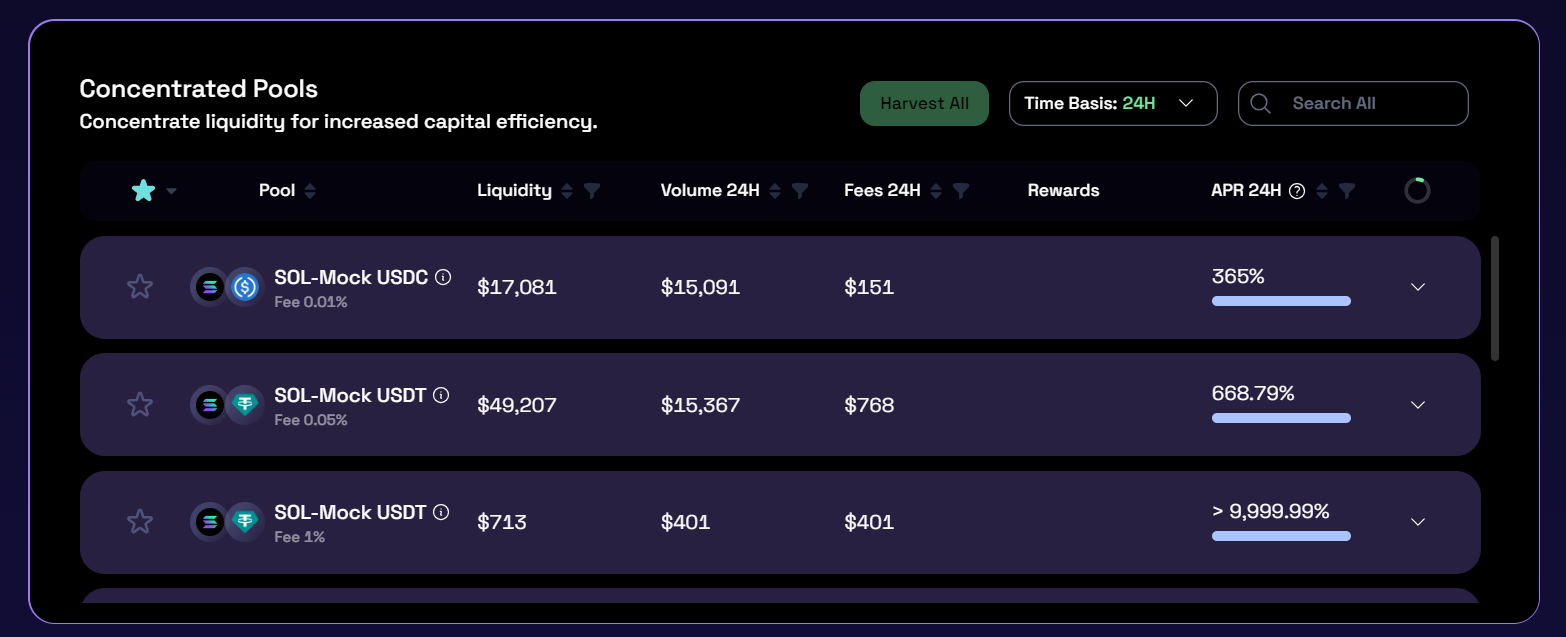
To calculate the overall Annual Percentage Rate (APR) for the pool, we make certain assumptions. We extrapolate trading fees and emissions per block to encompass all liquidity within the pool, including positions that fall outside the specified range.]
Delta Method - Estimated APR for user positions
The Delta Method utilizes the inferred change (delta) in pool liquidity, based on user-defined position price range and size, to compute an approximate APR. The total quantities of each token can be determined using the following equations:
For estimation of the amounts of tokenA (*deltaX*) and tokenB (*deltaY*) we need to know *deltaL*:
After calculating for *deltaL*, we can calculate *deltaX* and *deltaY* using:
And can be calculated from:

.jpg?alt=media&token=e303af4f-292e-4d2c-9ab3-c0e471c73e2d)
.jpg?alt=media&token=61d216d2-87e0-4a10-9fb2-d9f52af8f796)
.jpg?alt=media&token=32039b87-58bb-4fef-bcdc-a4c29a42df29)
.jpg?alt=media&token=bef09e77-bbeb-455c-9cc4-1ed87637de6e)